


There’s something I don’t like about myself: I hate working out. I've tried every form of movement and I've never found one I enjoy. And yet, I’m an engineer who spends all day at a screen. I don’t have a choice.
One day, I stumbled upon an ad for a running app. It promised to lift lazyasses like myself from their couches, and through a series of tiny sessions, get them running five kilometers. Bold promise, but alright, I thought, let’s give it a try.
My first session was one minute of running, followed by ninety seconds of walking, repeated six times. I could barely finish but two days later, I went out again, this time following a colleague's advice: Run as slowly as you possibly can. Don’t be ashamed to make it a trot. So I did, and this time it felt achievable.
So, I stuck to the program for a few more weeks and all of a sudden, I could run for three minutes without stopping. Then five, then eight, then fifteen! All the way to completing the 5K in forty minutes, which is a terrible time by any real runner’s standard, but an enormous win for me.
The moment I clicked from knowing to doing was the moment I finished that first ridiculous one-minute session. That tiny early win is what created momentum.
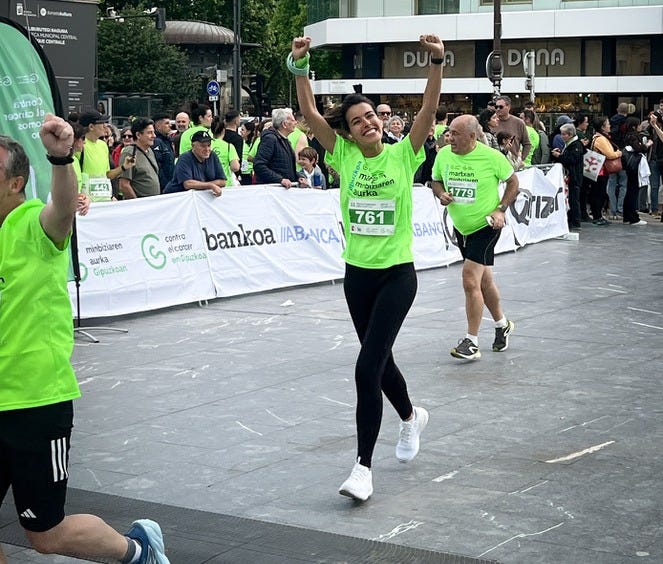
Whatever it is you know in your heart you should be doing, an easy early win can be incredibly helpful. But this isn’t the only way to make progress and I was curious to know what works for other people.
This is chapter three of After the Aha, my three-month collab with eight creators writing at the intersection of psychology, mindset, and inner work. Chapter one explored the lessons we keep relearning. Chapter two explored the ahas that hit years after they should. This chapter closes the arc with the question I most wanted answered when I started this series.
What moved you from knowing to doing?
(the aha turning into action)
Nathalie Cohen from the Nathalie Cohen publication
A little Substack gem, Nathalie’s publication is a place of wisdom and profound humanity.
I only moved from knowing to doing when I learned that awareness and action are two entirely different skills.
For years, I could perfectly explain why and how I became who I became, how my childhood had affected me, and why I acted the way that I did. And still, I kept on showing up in the same, self-destructive ways.
Only when I reached rock bottom, and the cost of my old behaviors finally had become larger than the subconscious benefits I was getting from them, I was “forced” to actually do things differently.
During that period, there were a few things that helped me greatly:
Finding a really good, action-oriented therapist who guided me with practicing new behaviors, one tiny step at a time.
Building a dedicated (Vipassana) meditation practice. It helped me to increase the pause before my response, so I can consciously choose what to do next instead of automatically reaching for old patterns.
Understanding that practicing new behavior is incredibly uncomfortable and scary at first. That does not mean you are doing it wrong.
Understanding that learning new behaviors requires constant practice. Slipping back into an old habit does not mean you have failed. Have compassion towards yourself, and try again.
Raquel Devillé from Ce n’est pas dans ma tête
Meaning “It’s not in my head”, Raquel’s publication offers nervous system regulation tools for highly sensitive and neurodivergent women.
Different techniques, at different levels. TRE brought me inner peace. For the first time, my baseline wasn't "brace for impact." Somatic Experiencing gave me something I hadn't felt in a long time: a genuine sense of security inside myself.
But Brainspotting is what made it all click into action. It deepened everything that came before and did something I didn't expect: it cleared the fog. No more procrastination. Sharper focus. Real concentration.
I went from understanding what needed to change to actually doing it consistently. Not through willpower. Through a nervous system that finally stopped getting in the way.
Wendy Tomlinson from The Empowered Mindset
One of the kindest voices on Substack, Wendy will lift your energy and make your mindset extra strong.
I always think the law of attraction is a bit like trying to lose weight. We know what we need to do, but doing it is sometimes a different matter entirely.
Two things moved me from knowing to doing. The first was understanding that the law of attraction is always working, always responding to the messages and energy we send out. That told me I needed to create a law of attraction lifestyle, not spend ten minutes on it every few days. The second was focusing on tools that fit my life and letting go of anything that felt too complicated or demanded time I didn't have. For me, those key tools have been affirmations, gratitude, EFT tapping, visualising and future focus writing.
That's how I built a doable lifestyle that made me a vibrational match for the life I wanted, every single day.
Kat Korobacz from Kat Korobacz’s Substack
Where CBT therapy meets the nervous system, Kat’s Substack is about how to turn understanding into movement.
Understanding the neuroscience of why change is so hard to sustain, or feels unreachable at times, long before I became a therapist myself. Before that, I was in a position a lot of people will recognise: standing on an island I knew completely, every path, every disappointment, nothing pleasant about it, but whether or not I wanted to admit it, it was familiar. Across the water was another island that pulled at me, one that seemed like it might actually fit. I could see it clearly, and through different therapy approaches over the years I kept being shown it more clearly but what I was never given was a way to deal with the water in between.
That’s what the neuroscience gave me: an understanding of why my nervous system read that stretch of water as danger, and how to work with that rather than trying to override it with willpower or more insight. That’s the piece I think is still missing from a lot of the advice people are given. Plenty of content will tell you that awareness dissolves a pattern, and there’s truth in that, but said plainly like that it does real damage, because it implies the work is basically already done once you’ve noticed something. It isn’t. Awareness is the start of the work, not the end of it. The gap between the two is exactly where most people get stuck.
What actually moved things for me was learning to work with the nervous system directly, and that’s become the whole shape of what I do now. If you’ve noticed a pattern and it’s still running the show, that isn’t a personal failure. It usually just means you’ve been shown the other island without ever being given a way across the water.
Shelly Roberts from Pen is Power
Shelly’s publication is a place to explore the cycle of Beliefs > Thoughts > Feelings > Actions > Results.
My body broke down, it literally stopped me working for several months — it was at this point, knowing I need to change the way I was working… all hours of the day and night, no breaks, little, if any, family time and not eating well, were all factors which led to a full blown burn out! Now I do the complete opposite and Burn Brightly ✨
Nicola Farnhill from Connected to Self
Nicola works with midlifers who, just like her, are done with survival mode.
What moved me from knowing to doing was the pain of suffering yet another cycle of a toxic and karmic relationship. When the pain of repeating became bigger than the pain of avoiding what I had pushed down and held inside me for too long. And the knowing that each time I avoided feeling what needed to be felt, I was disempowering myself, by acting inauthentically and denying my true identity. One of the empathic teacher of teachers.
Mahmoud Owies from Brilliantly Dark
Warm and profoundly honest, Mahmoud writes his own story in a way that lets you see yours.
I think this is related to question number two for me. This moment [Mahmoud’s dad passing] was big enough to shake me. For months afterward, I kept getting trapped in a false awakening dream loop (where I would wake up inside a dream over and over again and couldn't actually wake up). I felt like I was a prisoner of my own life. I hated my job, the environment, and the future I was promised, so I had no choice but to try and break free of it all.
Mac Dohm from The Personal Freedom Podcast with Mac Dohm and Porn Free Millenial
Mac’s work is about faith, courage, and the daily choices that can reshape a life, drawn from lived experience.
Action began when I stopped waiting to feel ready.
For a long time I thought motivation came first and action followed. Recovery taught me the opposite. Action often comes first, and motivation catches up later. The biggest changes in my life didn’t come from one emotional breakthrough—they came from building systems, inviting other people into my life, and choosing honesty over secrecy again and again. Accountability, community, therapy, and faith gave me a framework that turned good intentions into daily practices.
This framework has transformed the direction of my life. A few years ago, I made the unconventional decision to move into an RV and begin exploring the country. That season taught me that courage rarely feels comfortable in the moment. Whether it was rebuilding after divorce, traveling to places I’d never been, launching podcasts, or sharing my recovery story publicly, each step required action before confidence.
Real transformation happened when I stopped asking, “What do I know?” and started asking, “What am I doing?”.
Knowledge can inspire us, but it’s repeated action that quietly reshapes our identity.
Looking back, I don’t think confidence came first, it grew as a byproduct of consistently taking the next step, even when I didn’t feel ready.
A huge thank you to Nathalie, Raquel, Wendy, Kat, Shelly, Nicola, Mahmoud, and Mac for the honesty in every one of these answers. While reading them, maybe you noticed the same thing I did. Something in their story made them see that continuing was no longer an option.
That's the real gap between the aha and the action. When the cost of staying where you are becomes louder than the fear of moving.
If there’s something important tugging at your sleeve and asking you to make a change, it’ll keep poking until it’s heard. The choice is yours: you can act now, or act when it gets louder. But the keyword is always “acting” no matter how small that first step is.
So start small, start scared, but start.
Cheering for you, always 🤍
💬 If you were the ninth contributor to this piece, what would you say moved you from knowing to doing?
If you missed it, here are chapters 1 and 2:
The Lessons We Keep Relearning (And Why That's the Whole Point)

There was a time in my life when my diet was 90% sugar. I’m only exaggerating a little here. Breakfast was chocolate milk and cookies. Somebody brought croissants for their birthday? The perfect midmorning snack. Lunch was dessert first then some nibbling of real food, followed by fries. Afternoon snack was chocolate from the machine and dinner (if ther…
Why Understanding Something Doesn't Mean You'll Apply It

Seven years ago, if anyone had asked me if it was okay that they constantly beat themselves up, I would have said no, of course not. You should speak to yourself kindly. Trust me, you’ll perform better. I’d say this because I honestly believed it.
I’m again loving everyone’s perspectives! I so agree with you, Ilham, it often starts with taking just one tiny step and before we know it we’re running a marathon ;) thanks for inviting me to be a part of this series, and getting me introduced to so many other wonderful creators!!🤍
I really enjoyed reading this 3 part series, Ilham. You did a wonderful job bringing all these different voices together in such a coherent way and letting each story shine, including your own. And thank you to all the authors for sharing your stories and what drives you to act. Inspiring!