

What If We’ve Been Thinking About Meditation All Wrong?
Six creators reflect on the myths that make meditation harder than it needs to be.


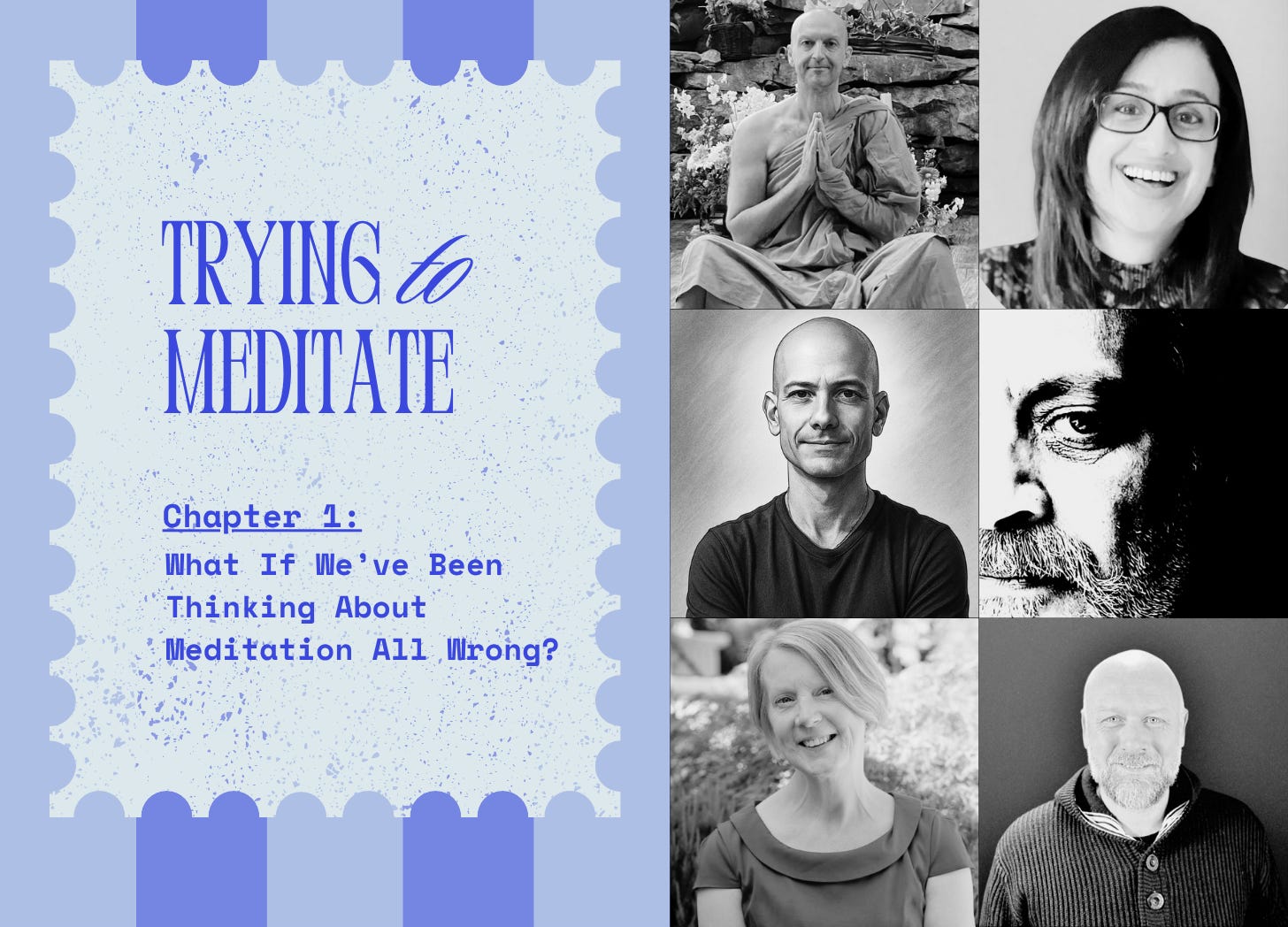
So many successful people — CEOs, psychologists, athletes, or creators — seem to agree on one thing: we should all take a moment, every day, to sit quietly and notice what’s happening inside of us.
Some call it mindfulness. Most of us know it as meditation.
Intimidating, isn’t it?
If you’re like me, you might have tried it a few times before giving up, thinking: I’m terrible at this.
Yet, the benefits are clear and science-backed. Studies show that even just a few days of consistent meditation can improve focus, and boost well-being.
Not only that, but here are some benefits I’ve personally noticed anytime I managed to keep at it daily for longer than a week:
Improved sleep quality
Immediate stress relief
A sustained sense of calm throughout the day
A clearer perspective on life’s problems
“Lightbulb” insights
Still, even knowing all this, I struggle to make the habit stick.
I’ll think: “How about a 10-min meditation session?” but then I’ll immediately feel that familiar resistance.
I’ll choose scrolling, reading, snacking… anything over sitting still.
Anything but listening to my own body and what my mind is trying to tell me.
I’m really curious about why that is. And I truly want to make looking inward part of my daily routine.
So, to help figure this out, I reached out to six creators I admire.
They’re writers, teachers, and thinkers who write about mindfulness or who are simply further along the path than I am.
I asked them five questions about meditation and decided to take you along for the ride. Each month, I’ll share their insights on one of those questions.
I hope their reflections will give us tools to approach meditation with more curiosity and less pressure.
For this first piece, I asked everyone the same question:
What’s the biggest myth about meditation you wish beginners knew?
Here’s what they replied.
Nick Hashemi from The Mindfulness Mentor: Peace Notes from a Former Monk
Nick’s work is truly special. A former Buddhist monk turned mindfulness mentor, Nick writes about Vipassana Meditation in a way that feels simple and doable.
“The biggest myth is that meditation is about peace, bliss, and relaxation.
When I first entered the monastery in Thailand, I thought I’d close my eyes, breathe slowly, and feel light spreading through my chest. Instead, what I met was pain, restlessness, and a storm of thoughts.
Meditation feels hard not because you’re doing it wrong, but because stillness reveals the truth. It exposes the mind’s habits, its clinging to the past and obsession with the future. True meditation isn’t about chasing good feelings — it’s about freedom, truth, and transformation.”
Sonia from Tranquil Nurturing Space
Sonia’s Substack is a place of poetry, reflection, and mindfulness. Her writing invites us to slow down and nurture body, mind, heart, and soul.
“One of the biggest myths about meditation is that it’s about stopping our thoughts. Our thoughts come and go and meditation is about noticing these thoughts with gentle awareness and returning again and again to the present moment. When we accept that it’s okay to have thoughts, it helps us move past resistance that can occur as they arise.”
Alexis Vale from Hidden Frameworks
Alexis explores the architecture of transformation with a fresh perspective. His unique work guides readers towards deeper alignment and meaning through spiritual curiosity and lived experience.
“The belief that you should feel something special during or immediately after meditation.
Many beginners think they’ve failed because they didn’t have a spiritual insight or because they didn’t feel instantly calm when they opened their eyes. But even after years of practice, those immediate “wow” moments are the exception, not the rule.
What actually changed my life wasn’t a single session, it was realizing, over time, that I was becoming less reactive to daily annoyances, both external frustrations and my own internal chatter.
Meditation works quietly. The long-term shift in how you respond to life usually appears far before any dramatic experience during a session. And because it’s subtle, beginners often miss that it’s already happening.”
VedicSoul from VedicSoul
VedicSoul writes beautifully about central themes of the human experience such as vulnerability and desire. He inspires us through ancient wisdom and his own profoundly human lens.
“The most prevalent myth is that meditation is about stopping your thoughts to achieve a state of blank, empty silence. This misconception sets one up for frustration, as the nature of the mind is to think, just as the nature of the heart is to beat. Meditation is not a war with the mind; it is the art of befriending it. It is about changing your relationship with your thoughts; what we can do, is learn to rest within the movement, to be the awareness in which all thoughts rise and fall.
When you release the burden of trying to “get it right” by emptying the mind, you uncover the essence of practice: the stilling of the fluctuations of the mind. Notice, I am not suggesting “the absence of thought,” but the stilling of its turbulence. This stillness arises naturally when we stop identifying with every thought that appears.
Over time, as we sit quietly and watch, the thoughts lose their power to carry us away. In that soft space of watching, peace dawns on its own; effortless, luminous, and deeply alive. This shift from control to gentle observation is profoundly liberating. It transforms meditation from a disciplinary chore into a sanctuary of presence, where every moment; whether filled with chatter or with stillness, is met with grace and accepted exactly as it is.”
Sue Reid from Confidence Matters by Sue Reid
Sue is a confidence coach with such an inspiring life story. She meditates every morning and says the practice has helped her a lot in her journey towards self-belief.
“You can’t get this wrong. Whether you keep your eyes open or closed, it doesn’t matter. You can sit, lie down, or walk. It doesn’t matter. If you just slow your breathing and focus on this moment, you are doing great.”
Paul Dalton (dharma⌁licious) from dharma⌁licious
Paul is a mindfulness meditation teacher who blends Buddhist teachings with modern life in a powerful way. His reflections make ancient teachings both digestible and practical.
“As with many beginners, when I first started meditating, the act of sitting still, turning inward, and focussing on my breath felt like a strategic way to escape the stresses of life. I thought the purpose of meditation was to empty the mind and feel calm. This belief not only fuelled much frustration and disappointment in my ability to be a ‘good practitioner’ but also prevented me from seeing what meditation is really for—to clearly witness and understand the impersonal nature of how this human experience works. It’s only through observing and understanding, that we are better able to foster a more easeful and compassionate relationship with life as it is.
The two big myths I help beginner students overcome are:
1 – There is no ‘meditationy’ kind of feeling you are supposed to experience.
You might sometimes feel peaceful, but then sometimes you might feel like a distracted, contorted mess. Both are equally valid. All that matters is noticing without judgment—accepting and allowing your experience to be just as it is and observing how it changes.
2 – Meditation is NOT the act of sitting still, crossed legged, with your eyes closed. It is the way in which you meet with, and give your full attention to, whatever you are experiencing in the moment. This means there is nothing you cannot approach as a meditation. Walking, eating, laying, conversing, stroking your pet, driving, or twerking – it’s all great material to work with. Formal sitting meditation just happens to be a particularly good training ground for the mind.”
Did you feel the wave of relief too?
It seems the voices in this piece agree on one thing: what meditation is not.
It’s not about silencing the mind, not about constant bliss and certainly not about performance.
Maybe the reason we can’t stick to it isn’t that it’s hard.
We’re the ones making the practice difficult by putting all this pressure on ourselves to “do it right”.
I’ll take it one step further:
If we’re not noticing our thoughts and intentionally bringing our mind back to the present, are we even meditating?
So there we have it: permission to sit still, let our mind wander, and gently bring it back, skipping right over the inner judgement.
What’s been your biggest struggle with meditation? Let’s talk about it below.
And if you enjoyed this piece, you’ll want to stick around for the next question I asked: “What are helpful ways you get past any initial resistance to getting started?”
 | A guest post by
|
 | A guest post by
|
 | A guest post by
|
 | A guest post by
|
 | A guest post by
|
 | A guest post by
|
Thank you @ilhamc for this thoughtful synthesis of voices, each echoing the same timeless truth from their perspective.
And I am sure it will be a relief to many readers to know that meditation is not about perfecting the mind, but about rediscovering the silent, spacious awareness that already holds it, "the sākṣī, the witness", forever undisturbed.
Thank you for curating this beautiful chorus of clarity and for including me along with other brilliant contributors.
Very Grateful
🙏🙏
Such a joy to read all the contributions to this piece, Ilham. Thank you for putting this together, I'm sure it will give a lot of encouragement and confidence to those looking to begin or resume a meditation practice. And thank you for inviting me to contribute, it has been such a pleasure 🙏