

The Lessons We Keep Relearning (And Why That's the Whole Point)
Eight creators, eight lessons, one uncomfortable truth in common.

There was a time in my life when my diet was 90% sugar. I’m only exaggerating a little here. Breakfast was chocolate milk and cookies. Somebody brought croissants for their birthday? The perfect midmorning snack. Lunch was dessert first then some nibbling of real food, followed by fries. Afternoon snack was chocolate from the machine and dinner (if there was any) was maybe a burger with fries, maybe pizza, or sometimes a store-bought salad, but only if it was dripped in honey and added sugars.
Was I not aware this was a horrible diet? Of course I was.
Did I do anything about it for years? Nope.
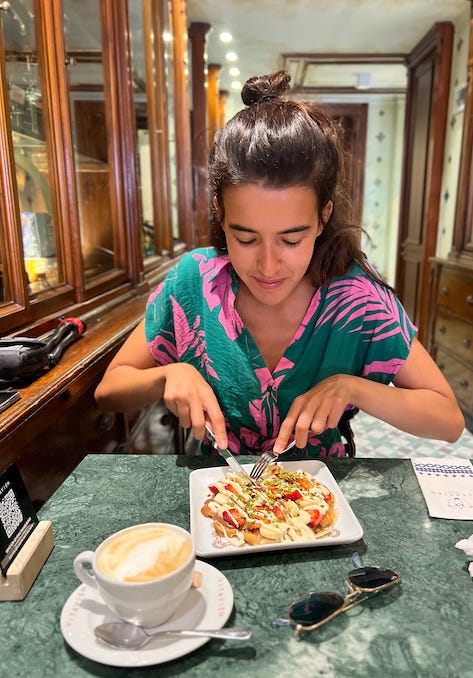
This is not a post on nutrition. This is a post on the gap between knowing and acting. In my case, that gap was bridged by a chronic disease diagnosis. But do things always need to get that bad before we actually get moving?
People-pleasing is bad. Overthinking is not worth it. Daily meditation will change you. It’s important to move your body, and so on, and so on…
We get the lesson and it might even hit us like an epiphany. We try it out for a while, but the relapse always comes back.
So I started wondering how this shows up for other people. I asked eight creators from different corners of psychology, mindset, and inner work three questions: What's a lesson you keep relearning?
What did you understand intellectually for years before you started living it?
What moved you from knowing to doing?
Their answers became this mini-series I’m calling After the Aha. Each question will be a post over the coming weeks and today we’re tackling the first one.
These are all people I admire and I loved their humanity and insights. I hope you will too.
What's a lesson you keep having to relearn? (the aha you have to keep re-having)
Nathalie Cohen from the Nathalie Cohen publication
A little Substack gem, Nathalie’s publication is a place of wisdom and profound humanity.
That you can’t choose your pain, but you can choose whether you multiply it. It is a lesson that I keep having to relearn, especially in life’s most mundane moments.
The other day, I came home after a long, draining day at work. When I opened the door, I was greeted by our screaming toddler, whose sister had “stolen” his toy, and our crying 4-month-old who needed to be fed. When I then asked my husband where the milk formula was that he had promised to buy, and he said he forgot - I felt my blood starting to boil. Before I knew it, I slipped back into a well-worn pattern: I started blaming everyone and everything for my misery. My husband. My kids. The Universe. Slowly, I let my mind build a case against my life.
In Buddhism they actually have a name for this: the second arrow. The first arrow is the unavoidable pain of a difficult event, the second arrow is the pain that we add by dwelling on it. In that case, we don’t suffer once, but twice.
Later that evening, as I sat at the dinner table feeling particularly resentful, I remembered that I had a choice: I could keep compounding my suffering by feeding the story, or I could acknowledge the difficult feelings, feel them, and let them pass.
It is a choice I have to keep making again and again, but every time I do, it creates a little more space to deal with what is actually happening.
Raquel Devillé from Ce n’est pas dans ma tête
Meaning “It’s not in my head”, Raquel’s publication offers nervous system regulation tools for highly sensitive and neurodivergent women.
That rest is not the reward at the end of the to-do list. It’s part of the work.
I teach nervous system regulation. I help women slow down. And yet, I still catch myself running on empty, telling myself “just a little more.” The aha hits. I feel better. And then, a few weeks later, I’m back at it.
The thing is, knowing something intellectually doesn’t rewire your nervous system. The pattern was built over decades. One insight doesn’t undo that. So I keep re-learning the same lesson. Not because I’m failing, but because this is literally how the body works.
WENDY TOMLINSON from The Empowered Mindset
One of the kindest voices on Substack, Wendy will lift your energy and make your mindset extra strong.
One lesson I have to keep relearning is that I don’t need to fix everything for everyone. Where this comes into play most is with my mum and my son. Both are fully functioning, very capable adults, and most of the time all they need from me is to listen, to be present and to give my support. Not to fix.
In fact, when I forget this lesson, I end up taking away their power, and that’s something I never want to do. So I keep coming back to it.
Kat Korobacz from Kat Korobacz’s Substack
Where CBT therapy meets the nervous system, Kat’s Substack is about how to turn understanding into movement.
That coping and regulation are not the same thing. I can function under pressure, hold a lot, wear every hat required of me, that's simply who I am and what my work demands. But being able to cope is not the same as being okay. Working in acute, high-intensity environments keeps me in "go" mode by default, so I keep having to relearn that functioning well isn't proof my nervous system is settled. The question I keep coming back to is "am I actually okay, or just still upright?"
There's no single fix for this, partly because my work itself doesn't stay still. The environments I'm in, the intensity, the hats I'm wearing, all shift, which means what my nervous system needs shifts with them. A tool that worked last month can go quiet on me this month, not because it failed but because I'm not the same person in the same conditions I was when I found it. So it's a menu, not a prescription, and I have to keep checking what my body actually needs right now rather than what I think it should need by default.
What's changed most isn't the tools themselves but my relationship to my own nervous system. It's become an ongoing dialogue rather than a problem to solve once. Like any relationship, it needs attention, it needs me to keep showing up and asking rather than assuming I already know the answer from last time. So it's a journey in which I always feel like a student, because the person I'm learning about keeps changing too.
Shelly Roberts from Pen is Power
Shelly’s publication is a place to explore the cycle of Beliefs > Thoughts > Feelings > Actions > Results.
People are more important than pounds. People, especially those you love, fill you up with memories, feelings and energy in a way that money and “things” never can. So, I guess the lesson I have to keep relearning, is to make spending time with my loved ones my nº1 priority and not let work occupy too much of my time.
Nicola Farnhill from Connected to Self
Nicola works with midlifers who, just like her, are done with survival mode.
As an Empath, the lesson I have had to keep learning is one of discernment, of knowing when to give in, to let go, to no longer put in effort where it is not appreciated or wanted. Not to make my deep understanding of why someone does the things they do, the reason to empathize to the point of self-sacrifice. Some people cannot meet me where I am; they cannot see that I believe in them and their potential, and they can only make my staying a sign of weakness, which they ultimately exploit. Yes, my lessons in this situation are about knowing my worth and discernment.
Mahmoud Owies from Brilliantly Dark
Warm and profoundly honest, Mahmoud writes his own story in a way that lets you see yours.
I think I’m living inside a lot of loops, to be honest. But if I have to pick one, I think it would be that I should never waste my energy on someone who has made it so clear that they don’t want me or my energy in their life. I spent... and still sometimes spend... so much time overthinking my relationships with people who have already forgotten about me.
They’re not evil, and I’m not evil. Some people just won’t like your energy or thoughts; it doesn’t fit with how they want to live, and that’s always okay. What’s not okay is obsessing about it forever.
Break Free With Me (Mac) from The Personal Freedom Podcast with Mac Dohm and Porn Free Millenial
Mac's work is about faith, courage, and the daily choices that can reshape a life, drawn from lived experience.
The lesson I keep having to relearn is that personal freedom isn’t something you achieve once, it’s something you practice every day through a series of intentional actions and decisions. For me, freedom is both a destination worth pursuing and a state of mind that must be strengthened like a muscle through consistent repetition and daily habits.
There’s a part of me that still wants to believe I’ll eventually arrive at a place where discipline becomes effortless, the temptation to fall back into old habits disappears, or life settles into a constant state of peace. But eight years of recovery from pornography addiction and more than three years rebuilding my life after divorce have taught me otherwise.
Freedom isn’t built by one life-changing “aha” moment acting as a silver bullet. Those moments absolutely matter, they become milestones that remind us why we’re fighting. But lasting freedom is built through thousands of ordinary choices made long after the inspiration fades.
Every day, I’m casting another vote for the kind of man I want to become and the identity I want to inhabit. That’s why I keep coming back to the basics. I intentionally invest in my spiritual health, physical health, relationships, and passions. When I fall short in one of those areas, I no longer see it as proof that I’ve failed. I see it as a signal that I’m drifting and need to realign with what centers me.
As I was reading, I kept coming back to this thought: Every creator on this list is someone I consider deeply wise. They read, they teach, they've spent years doing the work. And every single one of them named a lesson they keep having to relearn. They all admit the same thing: The lesson comes back✨
So if you've been beating yourself up for knowing better and still falling into the old pattern, I want you to hear this: You're doing the exact thing every wise person does. You're relearning and that's what the work actually looks like.
The next post will take on the aha that hits late: What it looks like to understand something intellectually for years before we start living it.
Subscribe not to miss it 👇🏼
Oh my gosh, I love this article!! Well done to all of you!! :)
Reminded me of the saying: "what we do not learn from, will keep returning" Sometimes in different shapes and forms, but always the same lesson ;)
Thank you so much for including me and the lovely introduction you gave me. I'm so grateful for putting this post together to share such an important message. So often people feel like they're failing and they're not. They're just like all of the rest of us and need to keep relearning.