


When I’m dealing with a difficult emotion, I want it gone. Really, really fast. Like a bug landing on my arm, I just want to flick it away and go on with my day.
To achieve that, my first instinct is to reason my way out of the emotion, or distract myself until it fades away.
But unfortunately, this doesn’t make it go away. It only makes it stay longer, return louder or morph into a weird state of “what’s wrong with me today?”
Yet I struggle to do the thing all experts seem to suggest:
“Feel your feelings.”
“Make space for your emotions.”
“Allow the emotion to go through its sequence.”
What does that even mean?
My engineer brain wants a technical sheet or an operating manual. A breakdown of what I needed to think and do, in exact order and specific details. So I started collecting pieces from everywhere, testing them on my own nervous system. I'm not going to pretend I've cracked it. But I've found a few things that actually help. And they're specific enough that even my practical mind is satisfied.
Emotions and feelings aren’t the same thing
I learned an important distinction this week between emotions and feelings.
Emotions are sensations in the body. They’re physical data points, physiological events that last about ninety seconds.
Feelings are our mind’s interpretation of that data, and the reason a ninety-second event can stretch to hours or days.
Racing heart, heated face, burning chest —> Emotion.
Oh that’s anger. I’m feeling angry right now —> Feeling.
I’m currently on a medication with an inconvenient side effect: it makes my heart race. This misleads my mind into thinking that we’re nervous, even if nothing is actually happening. The data point is real. But I have to consciously strip it of any meaning beyond "this medication has an expected side effect."
If my doctor hadn’t warned me of that, I might have written a whole story about it. “My life is so stressful lately, it’s giving me anxiety. It must be because of this and that. Bla bla bla.”
Should every sensation become a feeling? No, and discernment is knowing which to ignore and which to address. The problem is that some of us were taught from a young age that certain feelings, like anger, weren’t acceptable. Over time, we got the message: These should be avoided at all costs.
So we did. We became masters at avoiding, escaping and numbing. We started to eat, scroll, drink, or shop our way out of discomfort.
Some of these strategies helped me cope for a while, but they always left me feeling worse. I want to do better now.
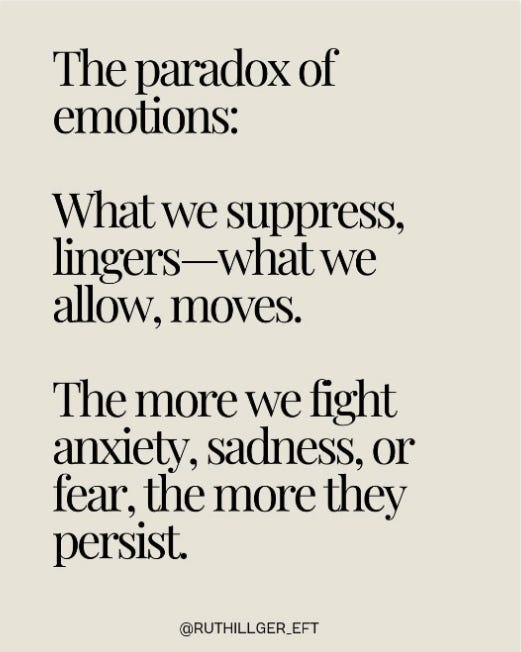
You can't reason your way out of a feeling
I spend way too much time in my head and this is a fact I want to change.
We live in a culture that glorifies the mind. The mind solves problems and produces tangible results. And because I see uncomfortable feelings as problems, my natural inclination is to understand, dissect and analyze them.
But explaining a feeling isn’t the same as feeling it. There’s no way to actually feel a feeling without connecting with its source: the body.
What I mean by that is sitting quietly and asking yourself:
Where do I feel this emotion?
Is it a tight chest? A clenched jaw? A knot in my stomach? Discomfort in my throat?
I try to become a curious observer. I sit with it like I’d sit through a thunderstorm.
We notice the lightning bolts, the various shades of grey in the sky, the raindrops.
And most importantly, we don’t try to stop it or fix it. We just sit with it, without beating ourselves up or trying to perform at it.
If you’re feeling absolutely nothing, don’t discard the practice. That can also be a sensation worth examining. What does the nothingness feel like? Look closer. A sensation of nothing is also a data point to observe.
How long can you stay?
This part is the hardest for me: Staying there without doing something else.
Part of me, the loudest one, always wants to escape this practice. My mind suggests snacks, emails, to-do lists, anything to feel comfortable again. But if I can resist, even for a few minutes, I end up feeling much better.
Sometimes I put my hand on the place where I feel the emotion and I try to make the moment less boring by looking closer. What sensations are you noticing? I ask myself. Where is it? Is it your gut? What’s that like? What color is it? A bright red, maybe? Or dark blue? Does it move slowly or does it have more of a beat to it, like a blasting speaker?

The key is to bring sort of a childlike wonder to the experience, a sense of deep curiosity.
And you don’t have to do this for hours. Baby steps are perfect. Two minutes here and there, maybe five when you feel like it. Some relaxing music in the background, maybe dim lights.
What happens is that the emotion tends to change shape and soften. It resolves in a way, and you don’t have to carry it for longer than needed.
Final thoughts
Feeling your feelings is uncomfortable. It can feel excruciatingly slow and boring. Why bother when a pint of ice cream can do the trick just fine?
Because it really doesn’t. It’s a short term fix that ends up making us feel worse. And I wish I could just dismiss this whole ‘feel your feelings’ approach as useless. But I have to admit that it works.
I can’t say I’ve mastered this. I still avoid and resist it. But the more I practice, the less afraid I am of difficult emotions.
If you’re learning this too, I hope this gives you a place to start.
We’re figuring it out together ✨
Liked this? Forward it to one fellow overthinker who could use an operating manual for emotions.
Subscribe for more pieces like this one, every Sunday ✨
If you want to go deeper on the body side of this, I collaborated with five creators who taught me so much:
When Meditation Feels Like a Failure

You sit down to meditate. Five seconds in, and that’s it. You’re already bored and restless.
I love how you are figuring your way through these common problems, Ilham. With your engineers brain too! My friend Larry Burton always has great tips for handling emotions. You might want to look him up. 💕
The emotion-versus-feeling distinction is really useful: the ninety seconds of body stuff versus the story we build on top of it. I'm sure I've turned plenty of ninety-second events into a whole afternoon. The engineer wanting an operating manual made me smile too - because that's kind of me as well! 😀